

How Much Does the Lack of a Common Language Really Cost in Your Print Shop?
Analysis of Hidden Losses
Print shops calculate the cost of paper very precisely.
They count machine clicks.
They calculate operator working time.
Very few calculate the cost of their own variability.
The cost of chaos does not appear in Excel as a separate line item.
It is not included in the budget.
It is not visible in unit cost calculations.
And yet, it has the greatest impact on margin.
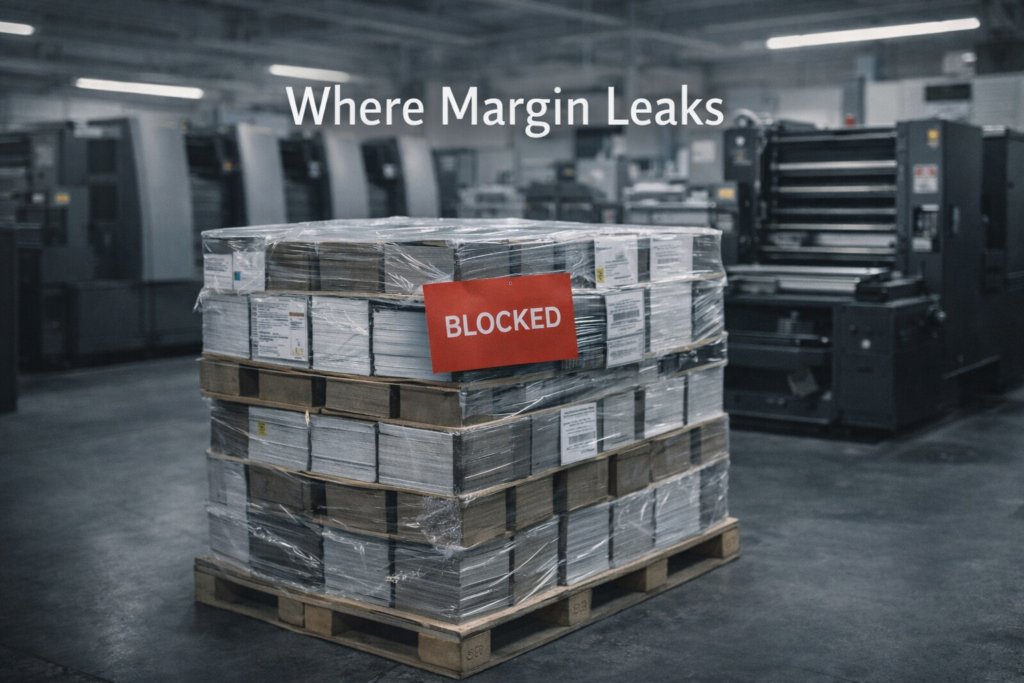
The Costs You See. And the Ones No One Wants to See.
Every production organization carries two types of quality costs.
The first are costs of conformance: planning, instructions, control, preflight, training.
The second are costs of nonconformance: errors, corrections, complaints, reprints, loss of customer trust.
In an unstable system, the proportions are reversed.
Prevention is reduced.
Errors are financed.
The lack of clear definitions of parameters, colors and job transfer rules is not a language problem. It is an economic problem.
It is a direct generator of nonconformance costs.
A reprint because “the tone was supposed to be warmer.”
A delay because “the change was in the email but did not reach production.”
A complaint because the client understood “proof approved” differently than the sales department.
Each of these cases is recorded as an incident.
None is recorded as the result of a lack of process regulation.
And that is the difference.
Investment in prevention, in a consistent information flow, in a standard of instruction, in clear definitions, is always less expensive than continuously financing errors.
Not because “quality is important.”
But because margin does not tolerate variability.
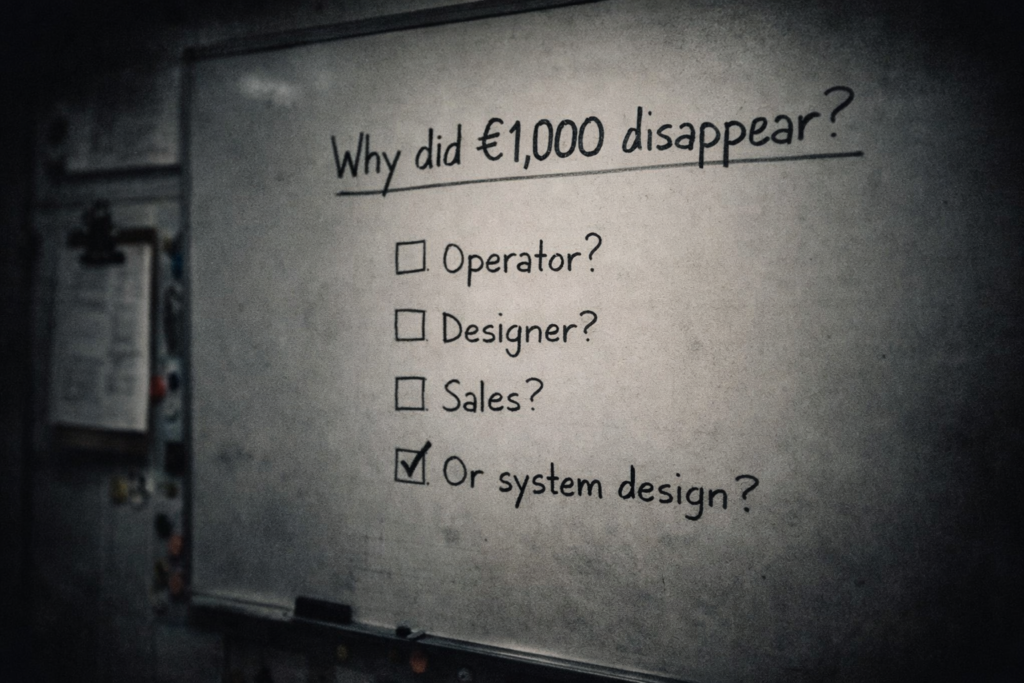
Simulation: A €1,000 Loss
Let us assume a simple situation.
A print shop loses €1,000 on a single job.
The reason: a color error.
A reprint. Material waste. Machine time. Logistics.
The first reaction?
“The operator made a mistake.”
“The designer prepared the file incorrectly.”
“The sales representative passed the notes incorrectly.”
Let us ask a few simple questions instead.
Why was there a color error?
Because the operator interpreted the comment differently than the client.
Why was it interpreted differently?
Because the description in the job order was ambiguous.
Why was it ambiguous?
Because there is no standard for describing color corrections.
Why is there no standard?
Because the organization did not recognize communication regulation as part of the production process.
At this point, we stop talking about the individual.
We start talking about the system.
€1,000 did not disappear because of carelessness.
It disappeared because there is no common language.
This is not an incident.
It is the cost of how the organization is constructed.
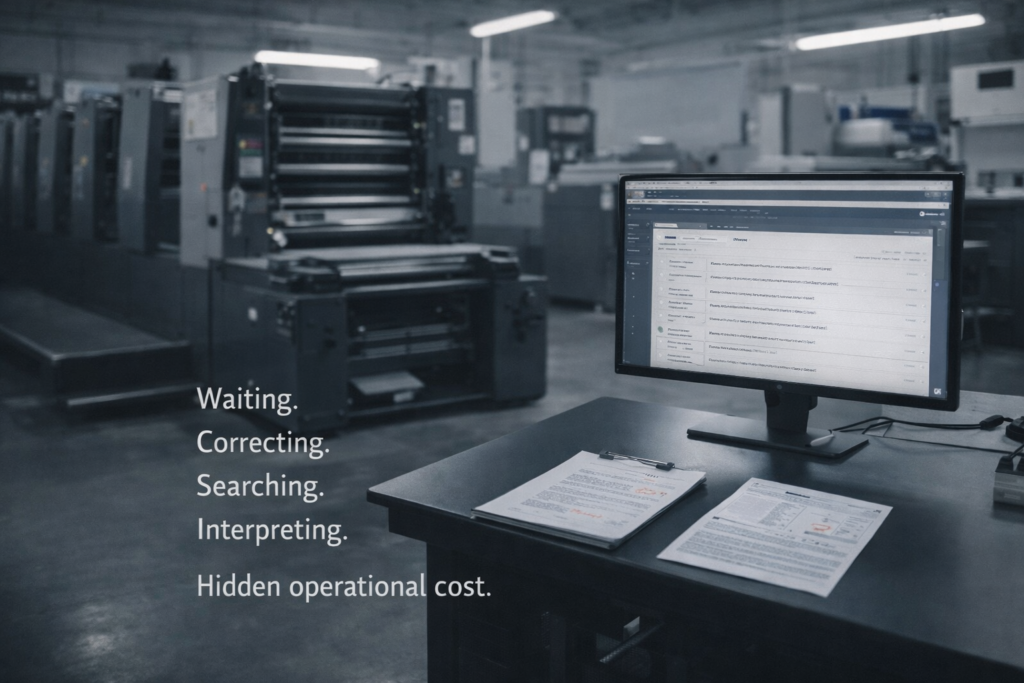
Hidden Losses in Daily Operations
The most expensive losses are not spectacular mistakes.
The most expensive factor is daily, repetitive variability.
Waiting for a decision because no one knows who makes it.
Correcting a file that “passed control.”
Printing extra “just in case.”
A shift manager resolving interpretation conflicts instead of managing performance.
An operator searching through emails instead of producing.
These are not minor issues.
They are fixed operational costs.
They do not appear as a separate line in financial reports.
They are dispersed.
Hidden in working time, small corrections and overtime.
And their common denominator is the absence of a stable information flow.
The lack of a common language is not a communication problem.
It is an economic problem.
Variability Costs. Stability Protects Margin.
Inconsistent, unregulated communication creates variability.
Variability creates unpredictable costs.
Unpredictable costs mean a lack of control over margin
In stable organizations, the process is regulated.
Instructions are clear.
Nomenclature is shared.
Errors are eliminated at the source, not corrected at the end.
This is not about the aesthetics of the printed sheet.
It is about system architecture.
A conversation about money in a print shop does not begin with the price of paper.
It begins with a question:
Is our process stable, or have we simply become accustomed to chaos?
Process regulation is part of margin construction.
And that is where it should begin.